1. Choose your times
Make the decision before the next reach.

THE KURB APPROACH
Choose a boundary ahead of time. Let your device support it. Review how it went.
Make the decision before the next reach.
Give your plan a physical boundary.
Keep what fits. Choose what to adjust.
These principles draw on behavioral research. Kurb itself is an early product and has not been clinically proven to reduce use or help people quit.
YOU MAY ALREADY USE THIS IDEA
If you’ve set an App Limit or Downtime, you know the idea: choose a boundary ahead of time, then let a tool help you follow it.
Kurb brings that idea to physical items. You set access times for your vape, nicotine pouches, or cannabis items, then store them in your device.
“I want a boundary around when I use these apps.”
The phone applies the limits you set.“I want my vape put away until the times I’ve planned.”
The Kurb device follows your access schedule.Both use self-chosen boundaries; their controls work differently. Kurb has no Apple integration or endorsement. Apple’s Screen Time guide.
THREE STUDIES BEHIND THE APPROACH
Three ideas that shaped Kurb. Here’s what the studies found.
PRECOMMITMENT
In a lab experiment, choosing a restriction ahead of time helped people wait for a preferred reward more often than relying on willpower in the moment.
Choose access times ahead of time. Your device gives that earlier decision a physical boundary.
A lab task with image rewards, not a Kurb trial.
SELF-DIRECTED MOTIVATION
Across 65 tests, interventions based on self-determination theory produced small improvements in health behaviors. Autonomous motivation and perceived competence helped explain those effects.
You choose whether to use Kurb, what you want to change, and your access schedule. The device supports that self-chosen plan.
These interventions used several forms of support. The analysis did not test Kurb or choice alone.
PROGRESS MONITORING
A review of 138 randomized studies, involving 19,951 people, found that monitoring progress improved goal attainment on average.
Review your device activity, notice patterns, and choose your next step with more context.
Unlocks record access, not total consumption. This review did not test Kurb.
These studies support the ideas behind Kurb. They do not establish Kurb’s effectiveness.
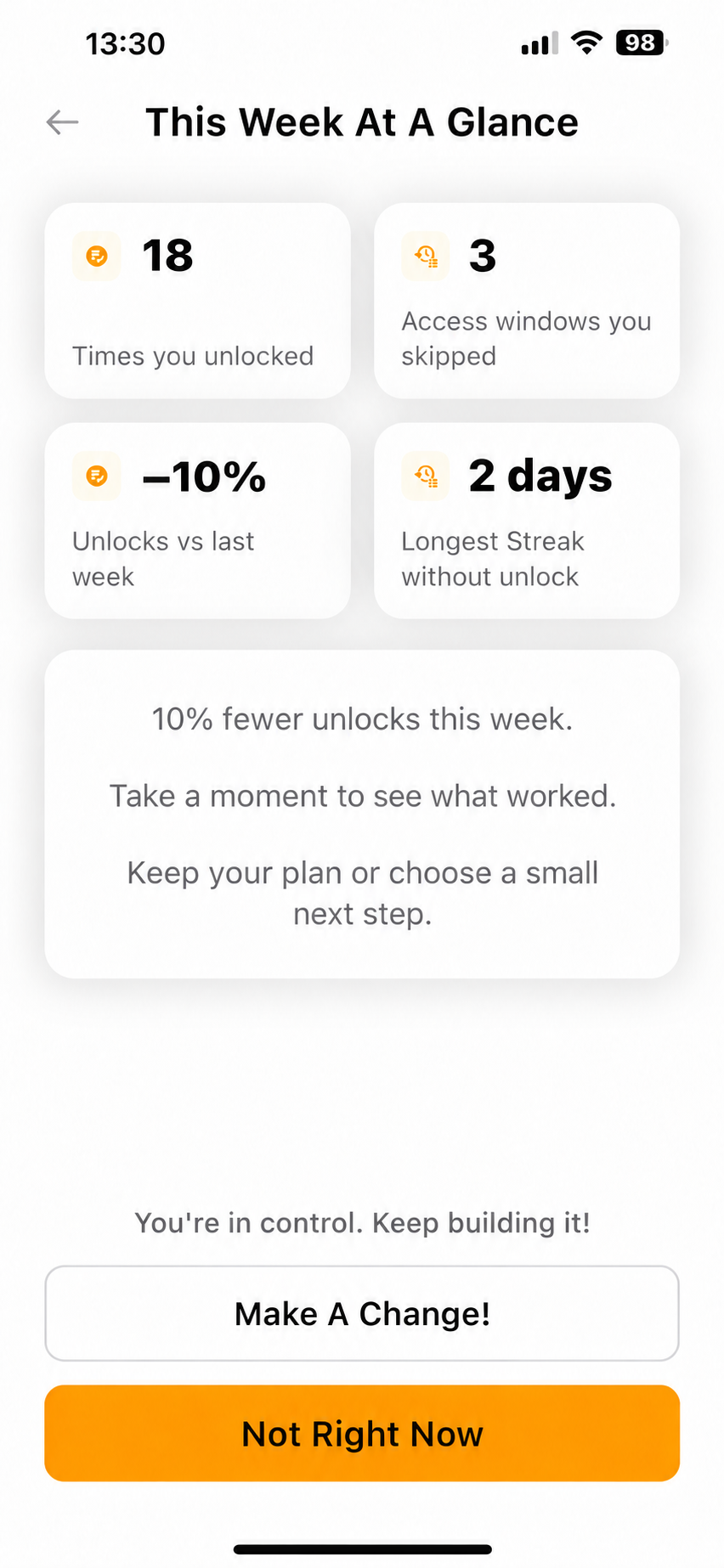
YOUR WEEK, MADE VISIBLE
The summary gives you a moment to look at your device activity before deciding whether to keep your plan or change it.
In this example: 18 unlocks and 3 skipped access windows.
18 unlocks is 10% fewer than the previous example week’s 20. It describes openings, not how much was used.
Keep the current plan, or connect your Kurb and save an adjustment. Changes start after at least 24 hours; the app shows when.
The 2-day streak shown here means time without a device unlock. It does not establish days without using.
ADDITIONAL READING
A review of self-control strategies explains how choosing or changing a situation can help before temptation becomes harder to manage. This informs Kurb’s emphasis on physical access.
Read the researchThis meta-analysis examines if–then plans that specify when, where, and how to act. You might pair a schedule with: “If I reach for my vape during a meeting, I’ll return to my notes.”
Read the researchFour experiments linked a compassionate response to setbacks with greater motivation to improve. That is a reason to review what happened constructively, rather than treat one day as a verdict about yourself.
Read the researchAn if–then plan is a personal exercise, not an additional app feature. These studies inform the approach; they do not establish Kurb’s effectiveness.
THE KURB PILOT
Help us learn how the device and app fit everyday routines.